The Book of Miter Doors
What began as an internal reference nearly a decade ago has become the most comprehensive guide to miter door construction we know of. We’re proud to share the first half of it here.
By The Pillar Machine Engineering Team ⋅ 10-minute read ⋅ 11 Sections
IN THIS GUIDE
01 Types of Doors
03 Material Selection
05 Workpiece Length
07 Tenon Dimensions and Location
09 Feature Fit
11 Resources and Downloads
02 Anatomy of a Framed Door
04 Plow Geometry
06 Machining Orientation
08 Mortise Dimensions and Location
10 Machine Angle Adjustment
What is this?
Over a decade ago, Jeff Hatch — owner and CEO of Pillar Machine — sat down to document everything his team knew about building miter doors right. What started as an internal training reference grew into the most comprehensive guide to miter door construction we know of. We’re sharing the first half here, free.
If you work with miter doors at any stage — whether you’re setting up a new line, troubleshooting joint quality, or evaluating equipment — this guide covers the process from raw material selection through machine adjustment. The second half covers gluing, assembly, clamping, and finishing, and will be published later this year.
01 Types of Doors
In cabinet door production, there are two main types of cabinet doors, American and European Style.
European Style is also referred to as Frameless construction, or slab or flat panel doors. These are typically single piece construction and therefore are not in the scope of this article.
Within the umbrella of American Style, or Framed construction door, there are several methods of joinery. The common methods include, Mitered, French Mitered, Coped, and Doweled construction. This article will cover mitered construction. We plan to slowly publish information on all of these methods in our series titled The Cabinetry Bible.
02 Anatomy of a Framed Door
Framed doors have three main components: Rails, Stiles, and Panel(s). Miter doors are typically 5-piece construction, however other joinery methods can incorporate more components for different aesthetics. Figure 1 below shows a standard miter 5-piece door, and Figure 2 depicts the parts of a stile/rail.

Figure 1: Parts in a Standard 5 - Piece Door
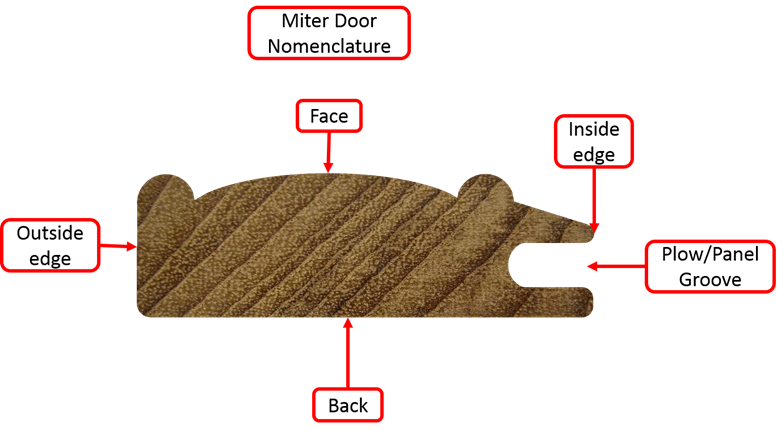
Figure 2: Stile/Rail Nomenclature
03 Material Selection
The profile you run through your miter machine has a direct effect on joint quality and finished door appearance. When selecting a profile, use one that lays flat on the face. If you have the ability to manipulate the profile, the best configuration has two outside points higher than anything in the middle. If your profile has a raised center point like the one shown in Figure 3, keep point #2 at least .010″ shallower than points #1 and #3.

Figure 3: Material Profile
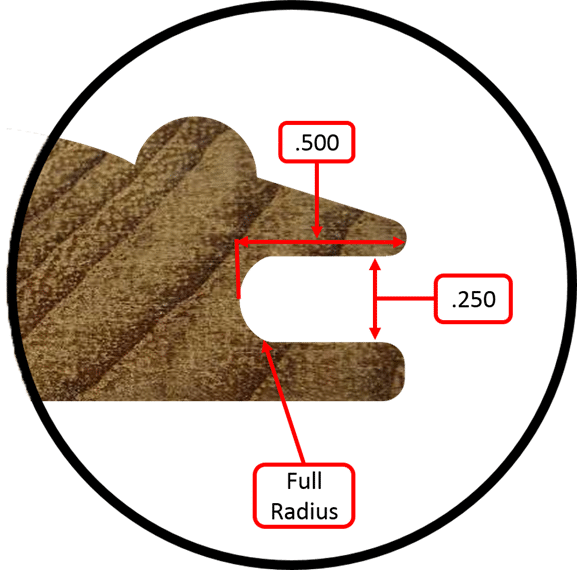
Figure 4: Plow Geometry
04 Plow Geometry
Since the most fragile portion of a miter door profile is the inside edge, it is important to pay attention to the shape and size of the Plow/Panel groove. The best shape for the Plow/Panel groove is no wider than .250 and no deeper than .500; it is best to have the bottom a full radius (as shown in picture to the left). This geometry gives the fragile parts more integrity.
05 Workpiece Length
Cut length
Cut each miter part 1/8″ longer than your finished door dimension. For a 12″ × 12″ door, cut all parts at 12-1/8″. When positioning the part on your crosscut saw, orient the Plow/Panel groove toward the inside fence. This places the majority of saw tearout on the inside of the profile, where the miter machine will remove it in the next operation.
Squareness
Your crosscut saw must cut parts square — this is as important as cut length. If parts come off the saw out of square, the miter machine cuts the wrong amount of material on each end, and your joint dimensions will be off before the miter operation even begins. Check your crosscut for square regularly.
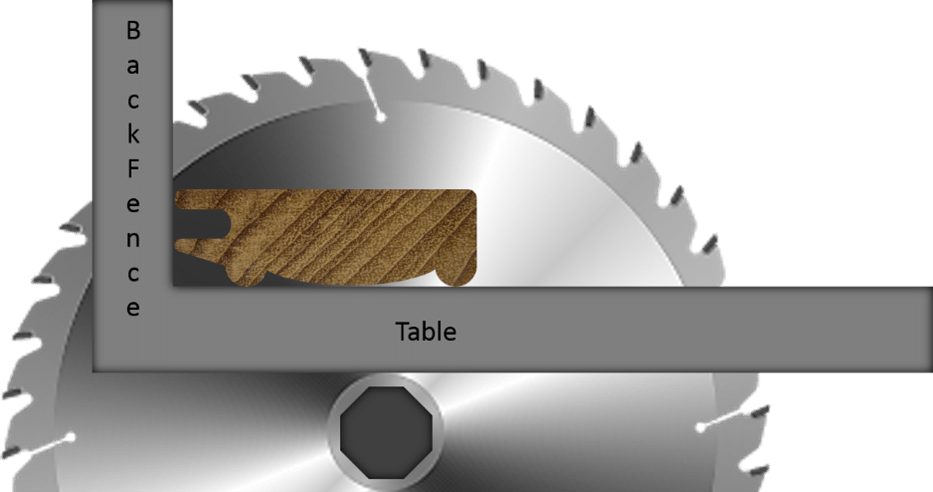
Figure 5: Part Orientation on the saw to ensure blowout is removed by miter processing
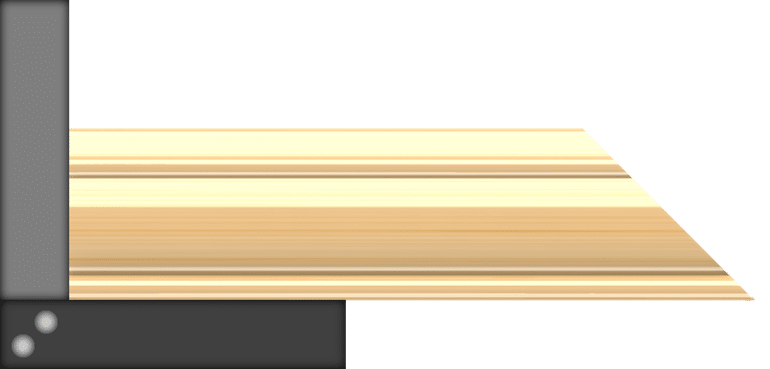
Figure 6: Squareness ensures satisfactory fit up post processing
06 Machining Orientation
Face down
Run parts face down through the miter machine. Any variation in material thickness will end up on the back of the door rather than the face, where it would be visible in the finished product.
Miter process
The machine produces a tenon at the left fence (Zone 1) and a mortise at the right fence (Zone 2). At Zone 1, the machine removes 1/16″ of material as it cuts the tenon; this cleans up any tear out from the crosscut operation. The same 1/16″ removal happens at Zone 2 on the mortise side, for the same reason
07 Tenon Dimensions and Location
The industry standard tenon height is .500″. At that height, you retain approximately .125″ of wall thickness between the outer edge of the door and the point where the tenon and mortise joint would become visible. That wall thickness is your margin; go deeper and you risk exposing the joint on the outside edge of the door.
Position the tenon start point at .625″ from the outside edge of the part. The mortise and tenon should be as long as the profile allow; a longer joint means more glue surface area and a stronger finished door.
08 Mortise Dimensions and Location
Cut the mortise .030″ deeper than the tenon is tall. This clearance serves two purposes: it prevents the tenon from bottoming out in the mortise before the joint faces close, and it gives excess glue somewhere to go during assembly. A tenon that bottoms out will hold the joint faces apart no matter how much clamping pressure you apply.
09 Feature Fit
The Shake Test
Before running production, verify your joint fit with this test: assemble one joint dry, hold one piece pointing straight down, and shake the joint moderately with the other piece unsupported. The joint should loosen slightly but not fall apart. If it falls apart, it’s too loose. If it won’t move at all, it’s too tight.
Target Measurements
Tenon thickness should be .001″–.003″ smaller than the mortise width. Tenon length should be .005″–.009″ shorter than the mortise depth. Both tolerances matter — thickness controls face gap, length controls bottoming out.
10 Machine Angle Adjustment
There are a lot of factors that go into making a miter door have all four corners tight. During your visual inspection of the door after assembly, if you see any corners that won’t close tight, the instinct is to adjust the angle on the miter machine. Before making that adjustment, check the following:
a. Parts are coming out of the crosscut saw within ± 1/128″ of target length.
b. The crosscut is cutting square within ± 2 arcminutes (± 2/60).
c. The back fence of the miter machine has less than .004″ of play.
d. The side fence has no play, and the adjustment bolts are tight.
Once all four are confirmed, run a minimum of 5 complete doors before deciding whether an angle adjustment is needed. If it is, adjust one side at a time in .005″ increments. Run 5 more doors and inspect all corners before touching the other side.
It’s also worth deciding up front how you want your corners to look at assembly. Wood expands and shrinks against the grain, not with it. If a joint is tight at assembly and the door is later exposed to more moisture than it was during matching and assembly, the joint will either close on the inside or open on the outside. For this reason, shops in humid climates typically assemble with all four corners tight. Shops in dry climates often leave a slight opening on the inside of the joint — when the door sees moisture in the field, that gap closes rather than pushing the joint open on the outside. An open joint on the outside is far more visible than one on the inside.